- Country/Region: Croatia
- Partner Organisation: AFZ, HAPIH, CASGB
- Breed of Sheep: Istrian, PAG
- Problem Being Addressed
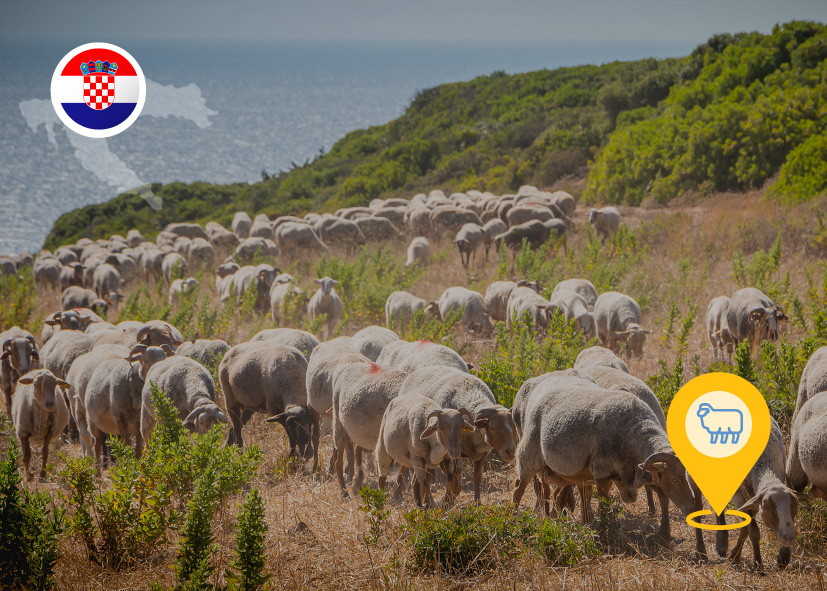
Small-scale dairy sheep farming in Croatia is increasingly vulnerable to the harsh realities of a changing climate. As Mediterranean summers become characterized by more frequent heatwaves and elevated temperatures, producers are facing a direct impact on animal welfare, reproductive outcomes, and overall milk yield, which ultimately threatens the economic viability of these traditional systems. While indigenous breeds, such as Istrian and Pag sheep, represent an invaluable genetic heritage with significant potential for climate resilience, we currently lack a comprehensive understanding of their adaptive mechanisms in response to intensified environmental stressors. Moreover, there is an urgent need for practical, cost-effective, and on-farm tools capable of identifying heat-tolerant individuals and monitoring animal well-being in real-time.
- Living Lab Activities and Approach
CRO-SRLL will act as a dynamic innovation hub, uniting the Faculty of Agriculture (AFZ), Croatian Agency for Agriculture and Food (HAPIH), and the Croatian Association of Sheep and Goat Breeders (CASGB) into a single collaborative unit (living lab). Our methodology will be focused on the co-creation of solutions, ranging from genomic profiling and environmental monitoring to the development of specially designed breeding programs, all validated through intensive testing on commercial farms. By embedding research directly into the production cycle, we will ensure that our strategies are not only innovative but also highly practical and easy to implement on the field. To address the challenge of identifying climate-resilient genotypes, especially for dairy production, the CRO-SRLL will adopt a dynamic, multi-stage approach:
- DATA COLLECTION AND THEIR INTEGRATION: The AFZ and HAPIH will collaborate to build a robust, comprehensive data-sharing platform. This phase involves longitudinal monitoring of milk yield, composition, and reproductive performance (collected in accordance with ICAR standards), which will be cross-referenced with local environmental and meteorological data. The animals will be genotyped using a 54K SNP chip. We will move beyond controlled experimental settings by performing in-situ testing. Selected commercial farms will act as the experimental units where candidate genotypes will be monitored under real-world conditions. The Croatian Association of Sheep and Goat Breeders (CASGB) will act as the essential link here, coordinating with breeders to ensure that testing protocols are scientifically rigorous yet operationally feasible within a commercial production cycle.
- IN-SITU VALIDATION AND TESTING: Advanced genomic analysis will be employed to pinpoint markers associated with heat tolerance and milk production. Specifically, we will perform Genome-Wide Association Studies (GWAS) to identify significant genomic regions, while reaction norm genetic models will be implemented to evaluate the plasticity of genotypes for different production traits under varying climatic stress levels.
- PARTICIPATORY CO-CREATION: Living Lab sessions and workshops will bring together scientists, regulators, and breeders to evaluate preliminary findings. AFZ, HAPIH & CASGB will play a pivotal role in this process by gathering direct feedback from all key stakeholders, which will enable the project team to refine breeding goals and intervention strategies. This iterative co-creation process will ensure that the resulting innovations will be practical, applicable, and readily adopted by the wider breeders’ community.
- Expected Outcomes and Impact
Identification of genomic markers for resilience – Identification of specific genomic markers associated with heat tolerance and milk production stability, providing a robust scientific foundation for future selection programs.
Validation of genomic plasticity – Providing a comprehensive characterization of how local genotypes express phenotypic variability in response to environmental stressors, thereby facilitating the development of precise management strategies.
Improved economic stability for producers – By identifying resilient genotypes, farmers will experience reduced production losses due to heat stress, leading to more stable milk yields and improved farm profitability.
Empowerment through co-creation – Through active participation in the research, breeders will gain a deeper understanding of genomic selection, effectively bridging the gap between advanced science and daily farm management.
Enhanced animal welfare – The developed strategies will directly improve the well-being of flocks by optimizing management practices tailored to local climatic challenges, ensuring healthier animals despite intensified environmental stressors.
- Contribution to Agriculture and Sustainability
Preservation of genetic heritage – The Lab will secure the future of Istrian and Pag breeds, ensuring that these invaluable genetic resources are not only conserved but optimized to thrive in a warming climate.
Sustainable rural development – By strengthening the adaptive capacity of the small ruminant sector, the Lab will support the long-term viability of sheep farming, transitioning traditional production into a more stable and resilient profession.
Policy and regulation alignment – The project will provide regulatory bodies with actionable insights, facilitating the integration of climate-resilient metrics into official national breeding and conservation programs.