- Country/Region: Turkey
- Partner Organisation: AYDIN ADNAN MENDERES UNIVERSITY
- Breed of Sheep: Karya, Kivircik
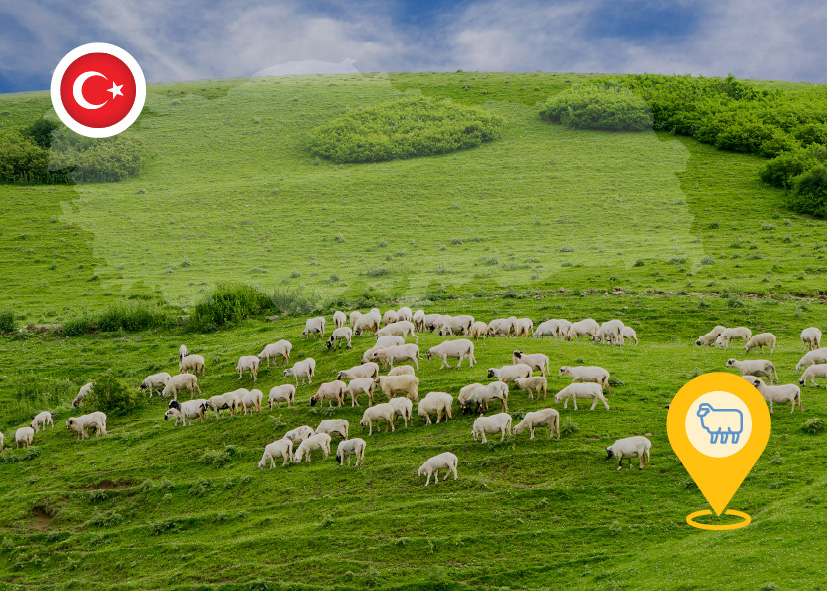
- Problem Being Addressed
The Turkish Living Lab aims to address the growing impacts of climate change on sheep production under Mediterranean environmental conditions, where increasing temperatures and more frequent heatwaves pose significant threats to animal welfare, reproductive performance, and meat and milk productivity, thereby compromising the sustainability of sheep farming systems. Indigenous sheep breeds reared in the Aegean Region of Türkiye, particularly Karya and Kıvırcık, represent valuable genetic resources with considerable potential for sustainable rural development. However, their adaptive capacity to heat stress has not yet been comprehensively characterized. Furthermore, cost-effective and field-applicable technologies for monitoring heat stress and identifying animals with superior heat tolerance remain largely unavailable.
The Living Lab will establish a multi-actor innovation platform that brings together farmers, researchers, breeding organizations, animal scientists, and technology developers to co-design, test, validate, and refine innovative solutions under commercial farming conditions. Activities will include the collection of phenotypic, environmental, and genomic data, the assessment of heat stress indicators, the deployment of rapid monitoring technologies, and the development of climate-resilient breeding strategies. Continuous stakeholder engagement and active farmer participation will ensure that the proposed solutions are practical, scalable, and readily transferable to sheep production systems. Ultimately, the Turkish Living Lab will contribute to the conservation of indigenous genetic resources, enhance animal welfare and productivity, strengthen the climate resilience of the sheep sector, and support the transition towards more sustainable and resilient livestock production systems.
- Living Lab Activities and Approach
The Turkish Living Lab adopts a multi-actor, co-creation approach to develop, test, and validate climate-resilient solutions for sheep production under commercial farming conditions in the Aegean Region of Türkiye. The Living Lab focuses on the indigenous Karya and Kıvırcık sheep breeds, integrating scientific research with the practical knowledge of farmers and other stakeholders.
Comprehensive phenotypic, environmental, genomic, and flock management data will be collected from commercial farms. Heat stress indicators, production performance, animal welfare traits, and environmental variables will be monitored using advanced phenotyping tools, sensor technologies, and digital data collection systems. The resulting datasets will be analysed to identify heat-tolerant animals, validate genomic markers, and support the development of climate-resilient breeding strategies and SNP-based selection tools. Aydın Adnan Menderes University (ADU) will contribute through large-scale phenotyping and genotyping, bioinformatics analyses, and the development of a novel SNP panel for heat tolerance.
Stakeholder engagement is central to the Living Lab methodology. Farmers, breeders’ associations, animal scientists, researchers, extension services, and technology developers will actively participate in data collection, co-creation, testing, and validation activities. Continuous stakeholder feedback will ensure that the developed technologies, decision-support tools, and breeding recommendations are practical, cost-effective, and applicable under commercial conditions. Pilot demonstrations, training activities, FAIR data principles, harmonised protocols, and a central digital platform will support collaboration, knowledge exchange, transparency, and long-term sustainability.
- Expected Outcomes and Impact
The Turkish Living Lab is expected to generate scientific, technological, and practice-oriented outcomes that enhance the resilience of sheep production systems to climate change in the Aegean Region of Türkiye. A harmonised database integrating phenotypic, environmental, genomic, and flock management data collected from commercial flocks of the indigenous Karya and Kıvırcık sheep breeds will be established. These integrated datasets will support the identification of heat-tolerant animals, the validation of genomic markers associated with heat resilience, and the development of climate-resilient breeding strategies and SNP-based selection tools.
In addition, the Living Lab will deliver decision-support tools, standardised monitoring protocols, and evidence-based recommendations that enable farmers and breeding organisations to assess, monitor, and mitigate heat stress under commercial farming conditions. Pilot demonstrations and continuous stakeholder feedback will ensure that the proposed innovations are scientifically robust, economically viable, and readily applicable in practice.
The expected impacts extend well beyond scientific outputs. Farmers will benefit from improved flock management, enhanced animal welfare, reduced production losses caused by heat stress, and greater adaptive capacity to climate change. Breeding organisations will gain access to innovative genomic tools and selection criteria that accelerate the development of heat-resilient sheep populations. Furthermore, the Living Lab will contribute to the conservation and sustainable utilisation of indigenous genetic resources while strengthening collaboration among researchers, farmers, extension services, and policy-makers. By promoting knowledge transfer, accelerating the uptake of innovation, and fostering evidence-based breeding practices, the Turkish Living Lab will contribute not only to the long-term sustainability, competitiveness, and climate resilience of the Turkish sheep sector, but also to sheep production systems across other countries located in warm climatic regions worldwide.
- Contribution to Agriculture and Sustainability
The Turkish Living Lab contributes to improving agricultural sustainability by promoting climate-resilient, data-driven, and resource-efficient sheep production systems in the Aegean Region of Türkiye. Through the integration of phenotypic, genomic, environmental, and management data, the Living Lab will support the development of precision livestock farming practices that enhance productivity while reducing the adverse impacts of climate change on animal health and welfare.
From an environmental perspective, the identification and selection of heat-tolerant animals will improve the adaptive capacity of indigenous sheep breeds, reducing production losses associated with heat stress and contributing to the sustainable conservation and utilisation of valuable genetic resources. The implementation of evidence-based breeding strategies will strengthen the resilience of livestock systems while supporting biodiversity and long-term adaptation to changing climatic conditions.
Economically, the Living Lab will provide farmers and breeding organisations with innovative decision-support tools, genomic selection approaches, and practical management recommendations that improve production efficiency, reduce economic losses, and increase the competitiveness of the sheep sector.
Socially, the Living Lab will strengthen collaboration among farmers, researchers, breeders, veterinarians, extension services, and technology developers through a participatory co-creation approach. This collaborative environment will facilitate knowledge exchange, capacity building, and innovation uptake across the livestock value chain.
By combining scientific excellence with stakeholder engagement, the Turkish Living Lab will foster sustainable livestock production, accelerate the adoption of innovative technologies, and contribute to the long-term environmental, economic, and social sustainability of sheep farming in Türkiye and other regions facing similar climatic challenges.